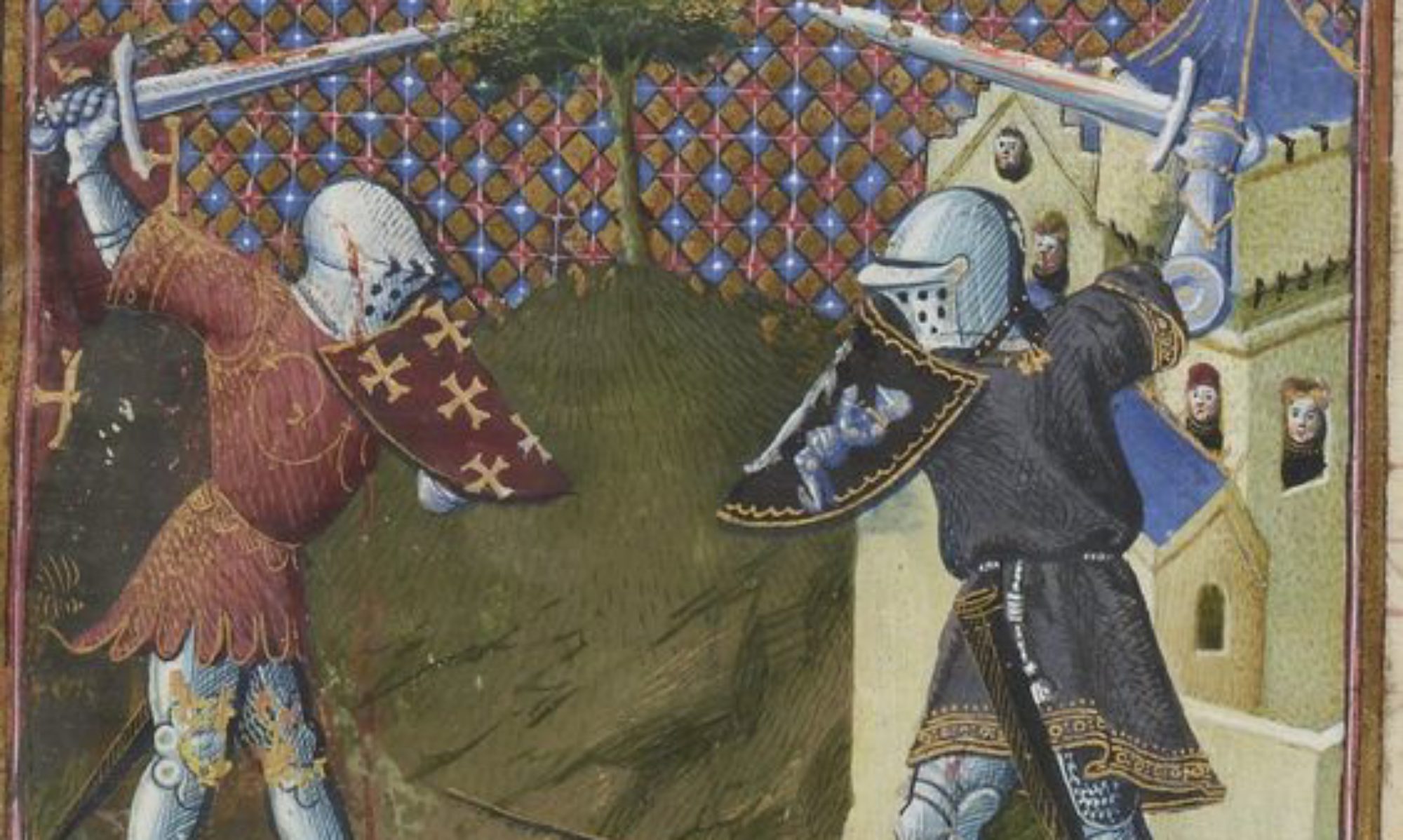

Arming standards for the heavy field
- Armor appropriate to a knight or man-at-arms in the 14th century.
- Please avoid the most common inaccurate SCAisms, such as a torse and mantle on a bascinet helm or bare arms under the arm harness.
- Armor on the lower legs and upper arms is mandatory. Sabatons are highly encouraged.
- Basket hilts, cup hilts, and hockey gloves are forbidden.
- Bar grills on helms are permitted for safety, but visors are highly encouraged.
- Shields shall be restricted in size. They must be within the shoulder-to-shoulder, chin-to-cup proportions of the wielder. This is a soft limit–a very narrow shield may be slightly taller. The point is to stay within the 14th century style.
- Shields other than bucklers must have a cloth cover unless they are made of wood. Wood shields with rawhide edging are highly encouraged.
- Two handed swords may be a maximum of six feet.
- Pole weapons must have a shaped head.
Combat conventions for the heavy field
- These are the default conventions for the day if none other are specified for individual scenarios. Combatants are encouraged and expected to issue their own challenges with their own conditions for victory: to first touch, to three counted blows, combatants only vulnerable to thrusts to gaps in armor, armor as worn, counted blows based on armor worn, etc.
- This is a tourney with bated blades, not a battle. Calibration is lighter than standard events. The intent is to best your opponent’s defense with a moderate blow. Victory shall be signaled by gesture, salute, or voice, not falling “dead.”
- There shall be no acting out of wounds. No fighting from the knees or losing arms. The default standard for victory is counted blows.
- In combat with counted blows, the fight shall continue with no pause after a blow lands. The next blow must come from a different angle or reset the shot; tactics such as three quick thumps on the head with wrist flicks are not what we want.
- Bar grills on helmets exist only for safety and are assumed to represent open faced helms.
- Metal armor is proof against single handed swords, but not single handed mass weapons such as maces and axes. Metal armor is not proof against any two handed weapons. If the weapon won’t kill you with a hip shot, metal armor is proof against it. Mail counts as metal armor.
- Melees shall be 360 engagement.
Arming standards for the C&T field
- Armor appropriate to a knight or man-at-arms in the 14th century, or garb of the same time period representing civilian wear. Combatants are encouraged to dress to one standard or the other, not (for example) a cloth kit with a single piece of armor.
- Swords appropriate to the 14th century are highly desired, but, recognizing the high cost involved, any single handed weapon legal for C&T with a blade length of 37” or less may be used. Longswords may be any legal length.
- Fencing masks may leave the face mesh exposed, but all other modern aspects must be covered with a hood.
- Shields shall be restricted in size. They must be within the shoulder-to-shoulder, chin-to-cup proportions of the wielder. This is a soft limit–a very narrow shield may be slightly taller. The point is to stay within the 14th century style.
- Shields other than bucklers must have a cloth cover unless they are made of wood. Wood shields with rawhide edging are highly encouraged.
Combat conventions for the C&T field
- This is a tourney with bated blades, not a battle. Victory shall be signaled by gesture, salute, or voice, not falling “dead.”
- Standard rapier rules for engagement, targeting, and calibration are the default. Combatants are highly encouraged to issue challenges with their own conditions for victory: to first touch, to three counted blows, armor as worn with metal proof against single handed weapons, etc. Reminder: we can not raise calibration, but we can declare certain types of shots as ineffective.
- The default standard for victory is counted blows. In combat with counted blows, the fight shall continue with no pause after a blow lands. The next blow must come from a different angle or reset the shot; tactics such as three quick thumps on the head with wrist flicks are not what we want.
- In scenarios where armor-as-worn is considered, these armor standards apply by default:
- Metal plate armor is proof against all weapons.
- Mail is considered proof against single hand cuts. It is not proof against two handed cuts or thrusts from any weapon. Ring mesh is modern safety equipment, not mail.
- Masks exist only for safety and are assumed to represent combatants with no head protection in scenarios where armor-as-worn is considered.
- Perf plate is considered coverage for safety and provides no protection where armor-as-worn is considered. A solid visor with holes drilled for ventilation in period fashion is considered metal plate armor.
- Halfswording with longswords is permitted.
- A certain amount of jostling is permitted. The standard rules forbidding grappling are in place, but body on body contact is allowed so long as it doesn’t become wrestling. Rules of thumb:
- Using body positioning and contact to block or impede is allowed. Pushing against a resisting opponent is forbidden.
- Applying pressure outwards is allowed. Enclosing or grasping an opponent is not.
- Combatants are allowed and encouraged to yield when vulnerable to attacks that are forbidden by the rules of the list (a threatened pommel strike, a potential shield bash, etc).
- As C&T melee is considered experimental, combatants may not issue challenges for melee scenarios with anything other than standard rules allowed by the experimental project.
Questions? Please contact your camp host.